Advanced processors like AI accelerators compute massive amounts of data while meeting rising speed, power, and reliability demands. Producing these devices requires fabrication processes that operate at minuscule scales. This leaves little room for error, making the manufacturing environment itself a critical part of the production process.
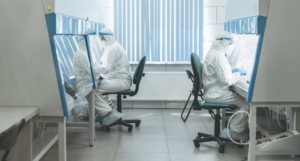
An engineered cleanroom controls airborne particles, electrostatic conditions, temperature, humidity, pressure, vibration, and material movement to improve product quality. As semiconductor manufacturers increase production capacity to meet demand for AI hardware, maintaining that control becomes more challenging.
The cleanroom’s storage systems, workstations, material-handling equipment, and environmental monitoring all play an integral role in a facility’s production. For manufacturers focused on yield, reliability, and throughput, these details are part of the manufacturing system.
Why Do Contamination and ESD Control Matter in Semiconductor Manufacturing?
Semiconductor fabrication is exceptionally sensitive to contamination. A particle that seems insignificant in an ordinary manufacturing environment can interfere with a critical step, affect a wafer surface, or cause a defective device.
Humans are a major source of particles due to skin cells, hair, and clothing fibers. Materials brought into the cleanroom can also carry contamination if they are not properly stored, packaged, or handled. Even moving carts and equipment can create additional opportunities for particles to enter sensitive areas or disrupt established airflow patterns.
Electrostatic discharge presents a different but equally important risk. Static electricity can accumulate during routine activities and discharge when sensitive electronic components are handled, potentially causing immediate damage or latent defects that may not appear until later in the product lifecycle.
Static charge can also create a contamination risk through electrostatic attraction. Charged surfaces can attract airborne particles and make those particles more likely to deposit and remain on sensitive surfaces. In semiconductor wafer fabrication, this electrostatic attraction of particles can be particularly important because even extremely small contaminants can affect critical processes and reduce yield.
For this reason, static control in a semiconductor cleanroom is about more than preventing damaging discharges. Managing electrostatic charge can also help reduce the risk of particle attraction and deposition.
The Infrastructure Behind Effective Semiconductor Cleanrooms
Filtration and environmental controls lay the foundation of a cleanroom, but the infrastructure around the manufacturing process determines how well that controlled environment can be maintained during daily operations.
What happens when an operator needs a frequently used component? If it’s stored too far from their workstation, retrieving it creates additional movement through the cleanroom. If storage is poorly organized, operators may handle materials repeatedly or temporarily place them in unsuitable locations. Difficult-to-clean carts can become another source of contamination as they move between areas.
These issues may not cause immediate failure, but their impact is cumulative. Over time, inefficient infrastructure can make contamination control harder, increase operator movement, slow production, and create more opportunities for human error.
Storage That Supports Workflow
Storage is often overlooked because of its indirect role in the fabrication process, yet how materials are stored can significantly affect both contamination control and work efficiency.
Shelving and storage systems in semiconductor environments must withstand routine cleaning and minimize surfaces where particles can collect. Cleanroom-compatible materials aid in this effort while providing organized locations for production materials, tooling, components, and other supplies.
Storage layout matters as much as the shelving itself. Positioning frequently accessed materials near operators limits unnecessary travel and handling, while a thoughtful layout can create more predictable material paths around sensitive processes.
This becomes increasingly important as production volume grows. A storage strategy that works for a small operation may create congestion and inefficiency as you add more operators, materials, and production equipment. The best storage solution scales with the facility and supports the workflow without creating new contamination risks.
Material Handling That Minimizes Contamination Risks
Storage is only one part of an effective material flow strategy. Once materials leave their designated storage locations, facilities need a way to move them through the cleanroom without introducing unnecessary contamination or disrupting production.
Carts and other transport equipment need to move materials efficiently while remaining compatible with the controlled environment. Cleanroom-compatible construction, smooth surfaces, and materials that resist shedding can make equipment easier to clean and maintain.
Selecting the cart is only one part of the equation. Facilities also need to consider where materials originate, where they end up, how often they move, and which routes they take through the cleanroom. Poorly planned material flow can crowd staging areas or require moving materials multiple times before they reach their final destination.
A well-planned material handling system keeps materials moving along predictable paths while minimizing unnecessary handling and disruption. By coordinating storage locations, transport equipment, and movement routes, facilities can support production without adding avoidable contamination risks.
Workstations That Support ESD Protection
Workstations are another point where product protection, contamination control, and operator efficiency intersect. Sensitive components can be exposed to electrostatic risks during assembly, inspection, testing, or other handling activities. An ESD-safe workstation establishes a controlled work area where grounding and conductive surfaces help manage static charge and reduce the risk of damaging electrostatic discharge.
Workstation construction also supports contamination control. Cleanroom workbenches should be designed to minimize features that can trap particles or interfere with cleaning. Eliminating hard edges and difficult-to-reach seams can help prevent wipes or apparel from catching on surfaces and generating particulate during routine cleaning or operation.
Materials and finishes must also withstand the cleaning agents commonly used in controlled environments. Surfaces that resist degradation from repeated exposure to cleaning chemicals can remain easier to clean and maintain over time, supporting consistent contamination control.
Workstation design also affects how operators interact with the process. Poorly arranged equipment can require unnecessary reaching, repositioning, or movement. In a controlled environment, those extra motions can increase particle generation while making repetitive tasks less efficient.
Cleanroom-compatible workstations address these considerations as part of the overall workspace. Ergonomic layouts can make it easier for operators to perform tasks consistently, while appropriately selected surfaces support both routine cleaning and long-term durability.
This is particularly valuable when a facility is designed around repeatable processes. A workstation should support the manufacturing procedure rather than force the operator to work around the infrastructure.
Small Infrastructure Decisions Matter
Not every cleanroom infrastructure decision involves major equipment. Cleanroom seating, for example, must withstand the demands of a controlled environment without becoming a source of particles or difficult-to-remove contamination. Packaging plays a similar role by protecting components as they move through storage and production areas.
Workspace organization also has a practical impact. When tools, materials, and equipment have designated locations, operators spend less time moving items out of the way or searching for what they need. That makes routine procedures easier to follow and reduces unnecessary activity around sensitive processes.
These details can seem minor individually. Collectively, however, they contribute to how predictable, maintainable, and contamination-conscious the cleanroom is.
Storage, material handling, workstations, seating, and packaging must work together to support the manufacturing process while maintaining the controlled environment around it.
Turn Environmental Control Into an Active Process
A cleanroom can be carefully designed and properly equipped, but maintaining performance requires ongoing visibility into what is happening inside the space. Air filtration systems and engineered airflow help control airborne contamination, while pressure relationships between spaces help prevent contaminants from moving into areas with stricter cleanliness requirements. Temperature and humidity must also remain within established parameters to support process consistency and help manage conditions that can contribute to ESD.
Monitoring provides the information needed to verify that those conditions remain stable. Particle monitoring can identify changes in airborne contamination before they become a larger production concern. Environmental sensors can track variables such as temperature, humidity, and pressure, giving facilities teams a clearer picture of cleanroom performance over time.
The value is not limited to responding to an alarm. Historical environmental data can help teams identify trends, investigate deviations, document conditions, and determine whether facility changes are affecting performance.
For example, an increase in particle counts may prompt an investigation into operator activity, material movement, equipment, or airflow rather than simply triggering another cleaning cycle. That distinction matters. Monitoring shifts contamination control from reacting to problems to identifying and addressing their causes.
Modern monitoring systems can also centralize data and provide automated alerts, making it easier for teams to respond when conditions move outside established parameters.
Designing Semiconductor Cleanrooms for the Next Stage of Production
AI demand is changing how manufacturers think about capacity. Facilities may need to expand production areas, introduce new equipment, alter workflows, or accommodate larger material volumes without compromising the environmental conditions on which existing processes depend. Designing for that growth from the beginning can make those changes significantly easier.
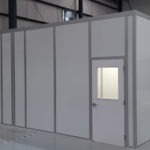
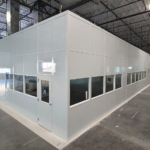
Modular cleanroom construction is one approach to this challenge. Modular systems can provide flexibility when production requirements change, allowing facilities to expand or reconfigure controlled spaces without approaching every modification as a completely new construction project.
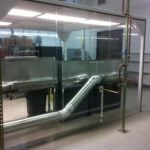
PAC’s semiconductor cleanroom projects demonstrate how this flexibility can be incorporated into the design. In one project, a modular wall system and specialty doors allowed the facility to accommodate large semiconductor processing equipment while preserving cleanroom integrity during equipment movement. The facility was also designed with airflow, pressure control, digital fan filter units, and environmental monitoring integrated into the overall system.
Scalability also extends beyond the cleanroom walls. Storage, workstations, material-handling routes, monitoring systems, and access points must accommodate changing production requirements. Planning these elements together can help manufacturers avoid a common problem: expanding production capacity while creating new operational bottlenecks.
Cleanroom Infrastructure and the AI Chip Manufacturing Process
Advanced AI chips depend on extraordinary precision, but that precision does not begin and end with fabrication equipment. The surrounding environment plays a direct role in protecting that equipment’s output.
Contamination control is a continuous process. It depends on maintaining the cleanroom environment while also controlling the everyday activities that occur inside it. Storage affects movement. Workstations impact ESD protection and operator behavior. Material handling changes how frequently products and equipment move through controlled areas. Monitoring provides the visibility needed to detect changes in environmental conditions.
For semiconductor manufacturers expanding AI chip production, that distinction matters. Infrastructure designed around contamination control, efficient workflow, and future growth can help reduce preventable disruptions while supporting the consistency required for advanced manufacturing.
Need help building a cleanroom? Reach out to a PAC Cleanroom Expert today!